
About Me
 Jack Lim
 Hi, I’m Jack Lim, a Certified Networking professional with expertise in Cisco Technologies and CompTIA Network+. I’m passionate about exploring emerging trends in IT, cloud computing, and cyber-security. Through my writing, I share insights, tutorials, and practical advice to help others grow in their tech careers.
FEATURED
Posted by - Jack Lim -
on - May 12 -
Filed in - Technology -
Cybersecurity Certifications CISSP CISM SecurityX GIAC Certifications CCSP Cybersecurity Career 2026 -
2K Views - 0 Comments - 1 Like - 0 Reviews
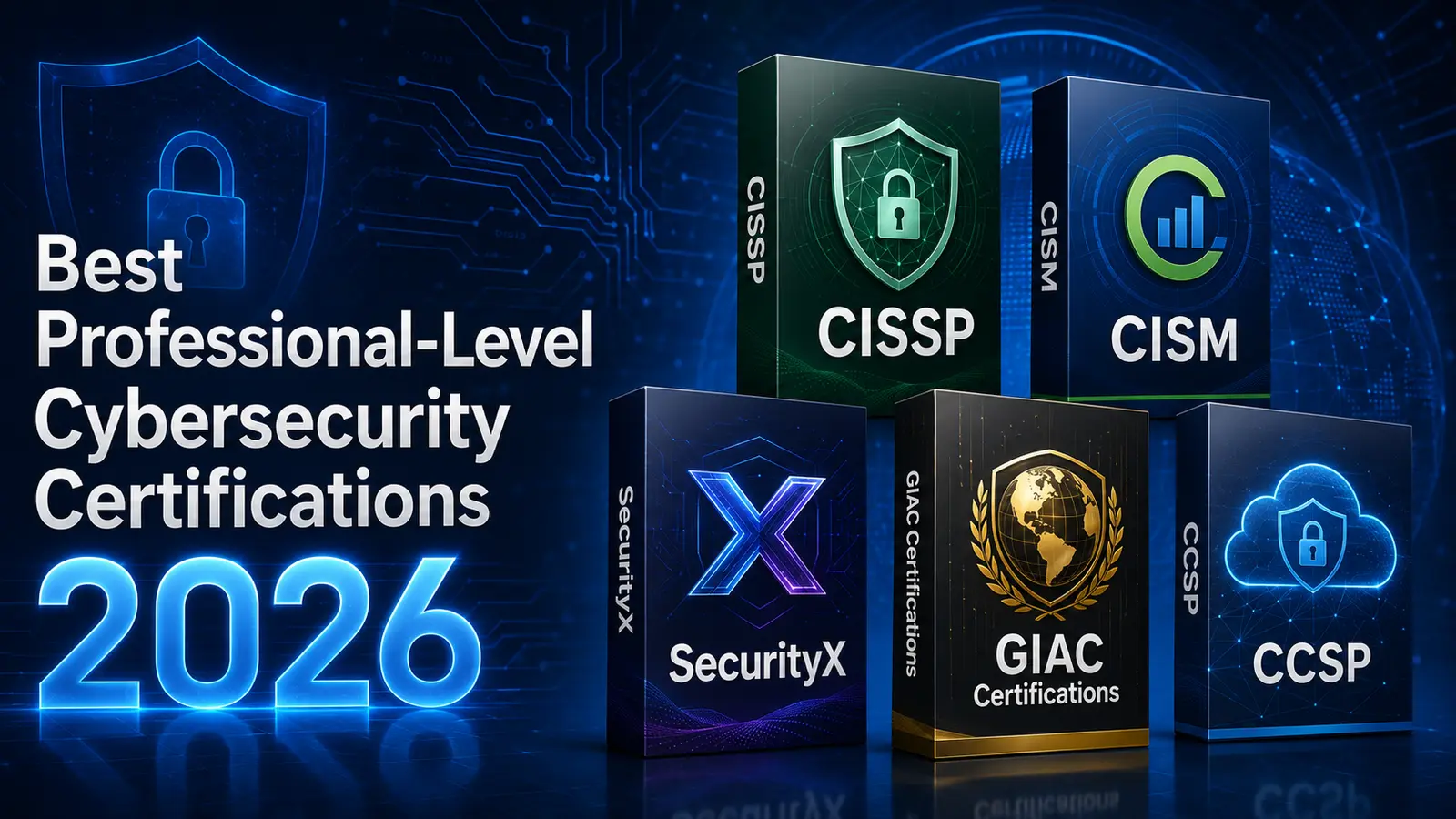
Cybersecurity careers in 2026 are becoming more specialized, more senior, and more connected to business risk. Security experts are no longer judged only by tool knowledge. Employers want professionals who can design secure systems, manage risk, respond to incidents, lead security programs, protect cloud environments, and explain cyber decisions to leadership.
This is where professional-level cybersecurity certifications matter. They help experienced candidates prove that they understand security beyond entry-level concepts. The best certification depends on your role. A security manager may need CISM. A senior security architect may choose CISSP or SecurityX. A cloud security specialist may choose CCSP or a vendor security certification. An incident responder may get more value from GIAC certifications like GCIH or GCIA.
A professional-level cybersecurity certification usually tests experience, judgment, and applied security knowledge. It is not only about knowing definitions. These certifications often focus on architecture, governance, security operations, incident response, enterprise risk, secure design, audits, compliance, cloud security, and leadership.
CISSP, for example, requires at least five years of cumulative full-time experience in two or more CISSP domains, although one year can be satisfied through certain degrees or approved credentials. CISM also requires five or more years of professional work experience across CISM domains, with a focus on information security management.
That is why these certifications are better for people who already have security experience. Beginners can study them, but the real value appears when the certification matches actual work responsibility.
CISSP remains one of the most recognized professional cybersecurity certifications. It is best for security architects, security managers, consultants, senior analysts, governance professionals, and people moving into leadership roles.
ISC2 describes CISSP as a certification that proves ability to design, implement, and manage a strong cybersecurity program. This makes it valuable for professionals who need broad security knowledge across domains like risk management, security architecture, asset security, identity, network security, software security, and operations.
CISSP is not narrow. It is wide. That is both its strength and its challenge. It suits people who need to connect technical controls with business goals. If you want a certification that signals senior cybersecurity credibility across many industries, CISSP is usually one of the strongest choices.
Candidates who are leaning toward CISSP should also become familiar with real exam-style wording before the final preparation stage. This Cert Empire video provides a CISSP practice exam question session for 2026 and can help learners understand how CISSP topics appear in scenario-based questions: https://youtu.be/vns3i5ihlQs?si=NbwJMs3USsJ-56Hm
CISM is stronger for professionals who manage security programs rather than only configure technical controls. ISACA describes CISM as validating ability to assess risk, implement governance, and respond to incidents, with domains covering governance, risk management, information security program, and incident management.
This certification is useful for security managers, information security officers, risk leaders, GRC professionals, compliance-focused experts, and people responsible for building or improving security programs. It is especially helpful if your role includes policy, leadership reporting, risk treatment, program maturity, incident coordination, and business alignment.
CISM may not be the best choice if you want a deeply technical hands-on certification. Its strength is management, governance, and decision-making. For many senior security professionals, that is exactly the point.
CompTIA SecurityX, formerly connected with the CASP+ path, is an advanced-level cybersecurity certification for security architects and senior security engineers. CompTIA says it proves the ability to design, build, and implement secure solutions across complex environments while supporting resilient enterprise security and governance, risk, and compliance needs.
SecurityX is useful for professionals who want a technical senior credential but do not want to move fully into management. It fits security engineers, architects, technical leads, enterprise defenders, and professionals who work across cloud, hybrid, on-premises, and complex business environments.
Its value is strongest when paired with real implementation experience. If you design security solutions, review architecture, guide technical teams, or support enterprise-wide controls, SecurityX can be a practical professional-level option.
GIAC certifications are highly respected for hands-on cybersecurity skills. GIAC says its certifications provide rigorous assurance of cybersecurity knowledge and skill for industry, government, and military clients.
The best GIAC certification depends on your specialty. GSEC validates practical understanding of information security beyond simple terminology and supports hands-on security roles. GCIH validates ability to detect, respond to, and resolve security incidents using essential incident-handling skills. Other GIAC paths may fit intrusion analysis, penetration testing, cloud security, malware analysis, forensics, and security operations.
GIAC is often a strong choice for people who want technical depth. It can be expensive compared with some certifications, but its value is high in roles where practical security skill matters more than general management knowledge.
| Certification | Best For | Main Career Direction |
|---|---|---|
| CISSP | Security leaders, architects, senior consultants | Broad cybersecurity leadership and architecture |
| CISM | Security managers, GRC leaders, risk professionals | Governance, risk, security program management |
| SecurityX | Senior engineers and security architects | Enterprise security design and implementation |
| GIAC GCIH | Incident responders and SOC professionals | Incident handling and attack response |
| GIAC GSEC | Hands-on security practitioners | Practical security operations and technical defense |
| CCSP | Cloud security professionals | Cloud governance, architecture, and security controls |
Cloud security is now a major professional-level skill area. Security experts are expected to understand identity, encryption, shared responsibility, workload protection, cloud monitoring, governance, and compliance across cloud platforms. CCSP is often considered a strong certification for people who already understand security and want to focus on cloud environments.
CCSP fits cloud security architects, cloud governance professionals, consultants, security managers, and engineers working with AWS, Azure, Google Cloud, or multi-cloud environments. It is especially useful when your job involves cloud risk, architecture review, security policies, secure design, and cloud controls.
In 2026, cloud security is not optional for senior cybersecurity professionals. Even non-cloud security roles often touch SaaS, identity, remote access, storage, APIs, and cloud logging.
The best ROI depends on your job target. CISSP often gives broad recognition and is useful across many senior roles. CISM gives strong value for management, governance, and security program leadership. SecurityX is practical for senior engineers who want to stay technical. GIAC gives strong ROI in specialized roles where technical skill is heavily valued. CCSP is useful if your future is cloud security.
Do not choose only by popularity. Look at job descriptions for your target roles. If they ask for risk management, governance, and leadership, CISM may fit. If they ask for security architecture and broad program knowledge, CISSP may fit. If they ask for incident handling, threat detection, or technical defense, GIAC may give stronger value.
Cert Empire can support the final practice stage by helping learners review exam-style questions after they study official domains and build practical cybersecurity experience.
Choose a certification based on your next role, not your current fear of missing out. If you want to become a security manager, choose CISM. If you want a broad senior credential, choose CISSP. If you want advanced engineering credibility, choose SecurityX. If you want technical specialization, choose GIAC. If you want cloud security, choose CCSP or a cloud vendor security certification.
Also consider your experience level. Professional-level certifications reward real examples. When you study access control, think about systems you managed. When you study incident response, connect it to real alerts, logs, and escalation steps. When you study governance, connect it to business decisions and risk language.
The best professional-level cybersecurity certifications in 2026 are not the same for everyone. CISSP, CISM, SecurityX, GIAC, and CCSP all serve different career goals. The smartest path is to match the certification with the role you want next.
Security experts who combine certification knowledge with real-world experience, clear communication, and practical decision-making will stand out more than candidates who only collect badges. In senior cybersecurity roles, the certificate opens attention, but your judgment proves the value.
For an image-based breakdown, readers may review an earlier Instagram post by Cert Empire.
CISSP is often the strongest broad option for experienced professionals because it covers leadership, architecture, risk, operations, and program management across many senior cybersecurity roles.
CISM is better for security management, governance, and risk leadership. CISSP is broader and better for security architecture, senior consulting, and technical leadership across multiple domains.
Yes, SecurityX is useful for senior security engineers and architects who want to prove advanced technical ability across enterprise, hybrid, cloud, governance, and secure design environments.
GIAC certifications are worth it for specialists who need deep technical proof in incident response, intrusion analysis, security operations, forensics, penetration testing, or hands-on defensive roles.
CCSP is a strong cloud security certification for experienced professionals. Vendor certifications from AWS, Microsoft, or Google Cloud can also help for platform-specific security roles.
Read More: CCNA 200-301 Updated Exam Pattern 2026: Question Types and Time Management

At our community we believe in the power of connections. Our platform is more than just a social networking site; it's a vibrant community where individuals from diverse backgrounds come together to share, connect, and thrive.
We are dedicated to fostering creativity, building strong communities, and raising awareness on a global scale.


