About Me
 Untitle tech
We are a digital agency focused on creating modern, scalable, and high-performance digital products that help businesses grow and succeed. By combining strategy, design, and technology, we build solutions that improve user experience, enhance brand presence, and deliver measurable business results in a competitive digital landscape.
Posted by - Untitle tech -
on - Thu at 9:52 PM -
Filed in - Technology -
10 Views - 0 Comments - 0 Likes - 0 Reviews
A practical guide for founders who want to launch fast, spend less, and learn early
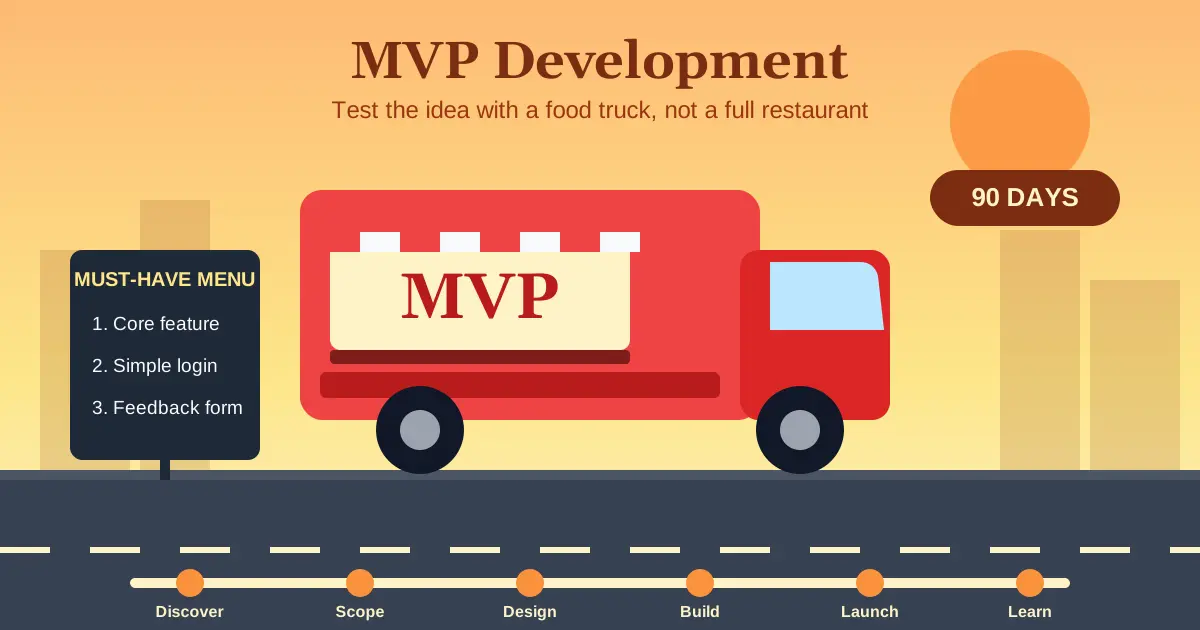
MVP development is how smart founders test an idea before they bet the whole budget. Picture a chef with a big dream. She could rent a huge restaurant, hire a staff, and hope customers show up. Or she could park a food truck downtown and serve three dishes. The truck tells her what people actually order. That truck is your minimum viable product.
In this guide, Untitle Tech walks you through a clear 90-day roadmap. You will learn what an MVP is, which features to build first, and how to measure success. We also share a real-style scenario and common mistakes to avoid. If you already have an idea and want expert eyes on it, reach out to our team today.
A minimum viable product is the smallest version of your software that solves one real problem for real users. It is not a rough draft. Instead, it is a focused product that delivers one clear benefit. Then it collects feedback so you can decide what to build next.
The idea grew from the lean startup movement. Its core loop is simple: build, measure, learn. In other words, you stop guessing and start testing.
People often mix these three terms. Yet each one answers a different question.
A proof of concept proves feasibility. A prototype shows the design. Only the MVP reaches actual customers.
First, some founders believe an MVP must look cheap. In fact, a good MVP looks clean and feels reliable. It simply does less. Second, others think an MVP means launching with bugs. However, quality still matters, because early users judge you fast. Third, many assume an MVP is a one-time event. Actually, it is the first step in a long cycle of learning.
Building a full product before testing carries serious risk. The odds of survival are not generous. According to the U.S. Bureau of Labor Statistics, only 34.7% of business establishments born in 2013 were still operating in 2023. Earlier BLS research also found that about 82% of new establishments survive from one year to the next during the first four years.
Those numbers do not predict your fate. Nevertheless, they show how many young companies struggle. An MVP lowers the stakes. It helps you find out early whether people want what you plan to build. Consequently, you spend less on wrong ideas and more on right ones.
There is also a talent angle. The BLS projects 15% growth in software developer jobs from 2024 to 2034, which is much faster than average. Hiring a full in-house team gets harder every year. A lean MVP needs fewer people, so it fits tight budgets better.
Here is the roadmap we use with startups across the USA. Think of it as opening a food truck. You research the neighborhood, pick a short menu, build the truck, and test it on real customers. The timeline below is a guide. Adjust it to your product.
Start by studying your customers. Talk to at least ten of them. Ask about their daily problems, not about your idea. Next, review competitors. Note what they do well and where they frustrate users.
By the end of week two, you should write one sentence that sums up your value. For example: "We help busy physical therapists send exercise plans to patients in under a minute." If you cannot write that sentence, keep researching.
Now you choose features. This step decides your success. List every feature you imagine. Then cut ruthlessly. Keep only what solves the core problem for your first users.
A simple method called MoSCoW helps here:
Aim for three to five "must have" features. As a result, your build stays small and fast.
Designers turn your scope into wireframes and a clickable prototype. Then you test it with five to eight real users. Watch where they hesitate. Fix those spots before any code exists. Fixing a sketch takes hours. Fixing finished code takes days.
Good design also builds trust. A clear layout and simple navigation make a young brand look professional. Our UI/UX design service helps startups reach that polish quickly.
This is the core of MVP software development. Your team builds in short sprints, usually one or two weeks each. After every sprint, you review working software. This rhythm follows the Agile approach. If you want to compare it with older methods, read our guide on Agile vs. Waterfall for US startups.
Two habits keep the build healthy. First, automate tests and releases early. A simple CI/CD pipeline for small development teams saves hours every week. Second, keep the code clean. Quick shortcuts today become expensive repairs tomorrow.
Launch to a small group first. Invite 20 to 100 users who match your target customer. Offer a direct way to share feedback, such as a short in-app survey or a quick call. In addition, set up basic analytics so you can see what people click.
Do not wait for perfection. Real usage teaches more in one week than planning teaches in one month.
Now review your data. Which features did users love? Which ones did they ignore? Where did they drop off? Then decide: improve, pivot, or stop. Each choice is a win, because you learned it cheaply.
For a wider view of how these stages connect, see our complete software development guide for US businesses and the phases of the software development life cycle.
Your tech stack is the set of tools that power your product. For an MVP, pick tools that are proven, popular, and easy to hire for. Exotic choices slow you down.
Consider these factors:
Should you build a web app, a mobile app, or both? Start with the platform where your customers already spend time. A web app reaches everyone with a browser. A mobile app suits products that need cameras, notifications, or offline use. Our web application development services and mobile app development services cover both paths.
Let us see the roadmap in action. Elena is a physical therapist in Miami. Her patients often forget their home exercises. She dreams of a full app with video libraries, chat, billing, and progress charts.
During discovery, she interviews twelve patients and four colleagues. One pattern stands out. Patients do not need a huge video library. They need a simple reminder with a short clip.
In scope week, she cuts her feature list from 22 items to four. The MVP will let a therapist pick an exercise, add a note, and send it by text. Patients tap a link, watch a 30-second clip, and mark it done.
She launches in week twelve with eight clinics. Within a month, she learns that clinics want weekly progress summaries. She builds that next. The billing feature she once loved? Nobody asks for it. She saved months of work.
Notice what Elena did. She started small, listened closely, and let users guide her. That is the heart of MVP development.
Without numbers, you only have opinions. Choose a few simple metrics before launch.
Set a target for each metric. For instance, "40% of new users send at least one plan in their first week." Clear targets turn data into decisions. They also help you explain progress to investors.
Watch out for vanity metrics. Page views and downloads look nice. However, they do not prove that people value your product.
Even strong founders trip on the same stones. Avoid these.
Many founders assume security can wait until the product grows. Unfortunately, that habit creates risk. If your app collects health, payment, or personal data, rules such as HIPAA, state privacy laws, and card industry standards may apply.
Two practical steps help. First, follow a trusted framework. The National Institute of Standards and Technology publishes the Secure Software Development Framework (SP 800-218), which lists simple habits such as code review and vulnerability testing. Second, use our secure software development checklist for US companies to build safe habits into each sprint.
You can build an MVP in-house, with freelancers, or with a development partner. A partner brings speed, experience, and a ready team. At Untitle Tech, we support founders at every stage:
MVP development turns a risky idea into a series of small, testable steps. You scout your customers, pick a short menu, design with care, build in sprints, launch to a small group, and learn from real data. Each step reduces waste and builds confidence.
Remember the food truck. You do not need a full restaurant to learn what people want to eat. You need a clear idea, a focused build, and the courage to listen. At Untitle Tech, we help founders do exactly that.
Ready to build your MVP? Contact our team today and share your idea. Together, we will map your first 90 days.
MVP stands for minimum viable product. It is the simplest version of your software that solves one real problem for real users. Teams use it to test demand and collect feedback before investing in a full product.
Most MVPs take about two to four months, depending on scope. Our roadmap targets 90 days from discovery to launch. Simple products can finish sooner. Complex ones, such as those with payments or strict compliance, may take longer.
Keep it to three to five core features. Each one should support the main value of your product. If a feature does not help users solve the core problem, move it to a later release.
A prototype is a model that shows how the product will look and feel. An MVP is a working product that real users can use. In short, a prototype tests the design, while an MVP tests the market.
Review your metrics and user feedback. Then choose one of three paths. Improve what works, pivot if users want something different, or stop if demand is weak. Repeat the build, measure, learn cycle with each release.
At our community we believe in the power of connections. Our platform is more than just a social networking site; it's a vibrant community where individuals from diverse backgrounds come together to share, connect, and thrive.
We are dedicated to fostering creativity, building strong communities, and raising awareness on a global scale.



